


With the ability to create and creatively employ leading-edge technologies, IT companies and departments seemingly have all the methods and answers required to resolve customer issues and deliver strong customer experiences (CXs).
Yet there are situations when even the most capable IT organizations need additional support to meet rising expectations.
That reality applies to a Boston-based managed services provider and managed security service provider operating across global markets. The organization blends deep human expertise with AI-driven automation to deliver cybersecurity, cloud, and digital transformation solutions for a diverse client base spanning financial services, life sciences, healthcare, education, legal services, and retail.
Clients are supported through a distributed operating model built around localized service groups referred to as PODS. These PODS are designed to understand specific customer environments and deliver personalized contact Centre support. Each POD is staffed with engineers and highly skilled professionals who provide continuous monitoring and issue resolution around the clock.
More than 40 PODS operate globally, each averaging approximately 12 specialists. They are supported by a global security operations Centre and a network operations Centre, ensuring resilience, visibility, and continuity across customer environments. These POD-based contact Centres form the backbone of the customer experience, enabling consistent, responsive, and tailored service delivery regardless of time zone or geography.
Facing Operational Pressure at Scale
Delivering fast, effective service for enterprise-grade clients brings operational complexity. As demand increased, the organization began experiencing challenges related to repetitive call volumes and inefficient phone routing systems. These factors reduced productivity and extended customer wait times, directly affecting service efficiency.
The need for always-on remediation capabilities made it clear that intelligent automation was no longer optional. In early 2024, the organization introduced a next-generation platform built on ServiceNow, leveraging two core automation solutions.
Advanced Work Assignment automatically distributes work items based on employee availability, capacity, and skills, ensuring optimal workload balance. Task Intelligence, powered by AI, enables language detection, record categorization, sentiment analysis, and document intelligence. These solutions were selected for their ability to integrate seamlessly with existing systems while providing scalability and enterprise-grade reliability.
As AI capabilities accelerated and customer expectations continued to rise, leadership recognized that deeper AI infusion into the contact Centre was necessary to fundamentally reshape operations. The goal extended beyond efficiency improvements to include the adoption of agentic AI capable of autonomous task handling and contextual decision-making.
Redefining Service Through AI-Enabled Collaboration
The strategic objectives were clear. First, bring engineering expertise closer to customers to reduce resolution time and improve first-interaction effectiveness. Second, enhance employee experience by allowing skilled professionals to focus on complex, emotionally sensitive, or ambiguous cases rather than routine administrative work.
In early 2025, the organization implemented an autonomous AI agent designed to manage high-volume, routine requests. These included case summarization that condensed detailed case histories into concise overviews, improved task prioritization based on contextual customer impact, and enhanced dashboards and operational level agreements to support outcome-driven performance management.
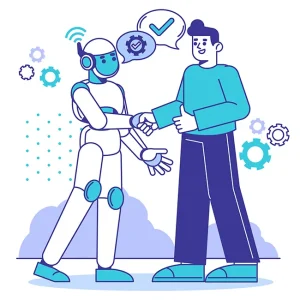
By shifting repetitive interactions to the AI agent, employees were able to focus on higher-value engagements that require judgment, empathy, and advanced technical knowledge. This approach supported a more collaborative workforce model where automation and human expertise complemented one another rather than competing.
Deployment followed structured change management practices emphasizing transparency and continuous feedback. The rollout included organization-wide communication, pilot testing, iterative refinement, defined success criteria, comprehensive training, and ongoing monitoring to ensure expected outcomes were achieved. Integration into daily operations was smooth, requiring minimal disruption and limited retraining.
The impact of these initiatives was measurable. First contact resolution rates increased to 73%, while enhanced monitoring thresholds enabled more effective alerting. Faster alert generation and improved event deduplication resulted in a 63% reduction in response times.
AI-enabled workflows allowed the organization to reskill 32 engineers, transitioning them from administrative intake roles into technical resolution positions. More than 315,000 tasks were routed automatically, saving approximately 21,000 manual hours within the first several months of implementation.
Engineers were able to concentrate on complex, emotionally nuanced interactions, driving higher engagement and a stronger sense of professional empowerment. Front-end intake processes previously handled manually were automated, allowing expert engineers to engage directly with customers from the outset. This reduced handoffs, improved accuracy, and accelerated resolution from the first interaction.
Customer satisfaction reflected these improvements, reaching an average of 99% over a six-month period. The contact Centre evolved from a transactional call-handling function into a strategic engine focused on technical triage, rapid resolution, and continuous professional development.
Maintaining the human touch remained central to this transformation. Key priorities included automating repetitive tasks, investing in employee upskilling, and ensuring a balanced model where technology enhances rather than replaces human connection. This hybrid approach preserved trust while improving operational efficiency.
Looking ahead, the organization plans to deepen AI integration while continuing to develop employee capabilities in soft skills and AI oversight. The roadmap includes expanded use of AI governance tools, advanced agent orchestration, collaboration platform integration, escalation management, and event consolidation. The long-term objective is a sustainable, human-centric contact Centre supported by intelligent automation.